Eberhard Faber Mongol 482 No. 2 Review

Introduction

^DC5B2C5DCCC65AEB6A2B9E41054B63984E94A1D22AEDF59CC6^pimgpsh_fullsize_distr

The Mongol series from Eberhard Faber is a famous one. John Steinbeck was said to prefer Blackwings and Mongol 480s. Here, I have a box of 482s, which look as school-like as pencil can look. Do they stand up to their lore, or has age gotten the best of them? Let’s find out.

Specs

Place of Manufacture: USA
Price: $20-25 a box, up to $200 for early 1900s version

Packaging

^DC5B2C5DCCC65AEB6A2B9E41054B63984E94A1D22AEDF59CC6^pimgpsh_fullsize_distrIMG_20160326_162309

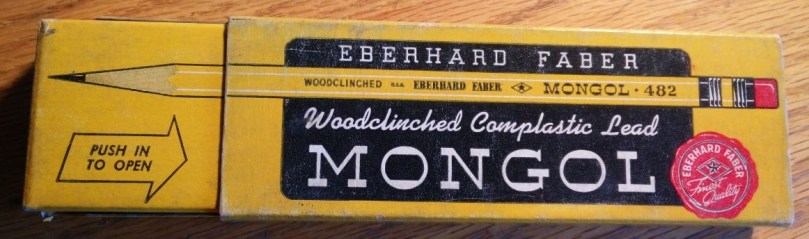
I love the box. It features a full size picture of the pencil on the front. There are many different fonts above and below it, drawing the eye to different sections. On the back, there is a brief description of the the pencil with the different hardnesses that it comes with. I believe this is the second generation of boxes. The first generation had an Asian theme to it.

It is two pieces, with one half larger than the other. The inner section pushes out to access the pencils.

The other sides of the box feature a similar design with the front with one of the edges having the hardness of the lead.

Fit and Finish

IMG_20160326_221302IMG_20160326_162443

Being a vintage pencil, it can be a bit difficult to judge quality. Over time, moisture and dryness can both affect the wood and the lacquer.

I immediately noticed a few issues with the printing. The printing was not very crisp and the lettering was not centered perfectly on the side.

IMG_20160326_221324

On the back, a bit of paint was chipped. It would appear as though this happened when the ferrule was attached. The ferrule itself has a gold band that has held up well over time. There is some discoloration on the black areas though.

Design

As stated before, the pencil has that school look to it. The yellow is similar to the cheap dollar store pencil shade and it has the pink eraser stuck to the end of it. That being said, there’s absolutely nothing wrong with a traditional look like this. In fact, I find it to be quite appealing, especially with the execution. The small details, such as the gold band around the ferrule and, once again, the fonts used really make this pencil stand out.

Functionality

IMG_20160326_220426

The pencil writes quite well. It has a tad of feedback like the Mitsubishi 9800 HB, but lacks some of the smoothness. It has a dry feeling on the paper rather. It doesn’t glide as much as move across the paper.

In comparison to modern Japanese pencils, such as the Hi-Uni and Mono 100, the pencil is harder. I like, however, how it produces a dark line while have little wear down. I can see myself using this pencil for a long time before sharpening. It compares well to a Cedar Pointe though I like the Mongol’s core a tad more.

Conclusion

I like the Mongol 482. It doesn’t write as nicely has a Blackwing 602 but it wasn’t meant to compete with it. The Mongol is a business and school pencil. It was designed for lots of writing and lots of use. Its original price point was low enough where you wouldn’t feel bad about losing it, comparing with the Blackwing which was a premium product.

I’m glad I picked up a box. I don’t think they’ll replace my Mitsubishi 9800s, but whenever I’m looking for a change, I’ll pluck one out of the box and give it a go.

Mitsubishi Vermillion and Prussian Blue Pencil Review

IntroductionIMG_20160319_163321

Red and blue combination pencils have been popular for a long time. They offer the user two contrasting colors in one writing utensil that can be used for tasks such as proofing, highlighting and drawing. Here, Tombow has produced a combination pencil with a unique ratio of red and blue. How well does this pencil work?

Specs

Place of Manufacture: Japan
Price: $7-8 for a box of 12


Fit and Finish

IMG_20160319_163302


Design


Functionality

IMG_20160319_163243


Conclusion


Mitsubishi Hi-Uni Review

Introduction

IMG_20160319_161307

The Mitsubishi Hi-Uni is a high end pencil. Two or three pencils equating the cost of a box of Mitsubishi 9800s, the Hi-Uni is supposed to be much better than its workhorse relative. But how much better can a pencil be?

Specs

Place of Manufacture: Japan
Price: $20-25 for a box of 12, $2-3 per pencil

Packaging

The Mitsubishi Hi-Uni comes in a nice plastic case when a dozen are purchased. There is an inner plastic divider to separate the two layers of six pencils. The build quality is quite decent and it keeps the pencils safe. I like it so much that I still use it to hold some of my favorite pencils.

Fit and Finish

IMG_20160319_161348

The level of detail and meticulousness that Mitsubishi has put into this pencil is amazing. The maroon lacquer is perfect (out of the box, that is) and there are no scratches nor is there chipped paint. The lettering is crisp and precise all around. The foil band around the end is straight and fits perfectly in the groove that is cut into the wood. The graphite core sits very centered. I have no complaints at all.

Design

IMG_20160319_161307IMG_20160319_161339

The design of the Mitsubishi Hi-Uni has one flaw: the clutter. The barcode on the backside along with the UPC set this back from other pencils such as the Blackwing.

Similarly, the multitude of fonts used on the pencil can make it an eyesore.

However, the colors used, red, black and gold, work well together.

Functionality

IMG_20160319_161754

The jump from a 9800 to the Hi-Uni is quite evident. The Hi-Uni has a much smoother core than the 9800 while maintaining a certain level of feedback. The pencil is obviously harder than a Blackwing 602, but will not lose to it in terms of smoothness. It has a bit of residue when writing with lots of pressure, but normal writing will erase well.

Sharpening the pencil is fun. The cedar the Mitsubishi has used in the pencil smells great and sharpeners glide through the wood.

Conclusion

The Mitsubishi Hi-Uni is a high end pencil. It features a good lead core, nice wood and great fit and finishing at a more expensive price. It has a few design issues, but overall, it is a great pencil.

Ohto Sharp Pencil (APS-350ES) Review

Introduction

IMG_20160313_173858

I love mechanical pencils. I love wooden pencils. The Ohto Sharp Pencil line tries to get the post of both worlds. It looks like a wooden pencil. It feels like a wooden pencil. But, 0.5mm lead comes out and the ferrule is actually a push button. How well does it actually work?

Specs

Place of Manufacture: Japan
Price: $5 (from Japan), $15 (Amazon)

Packaging

IMG_20160312_221558IMG_20160312_221835

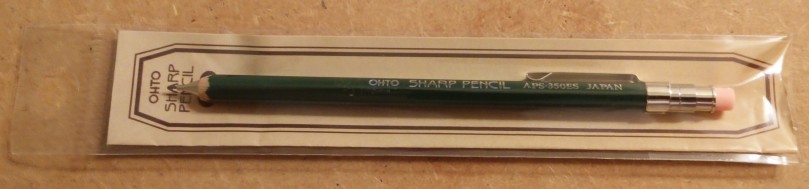
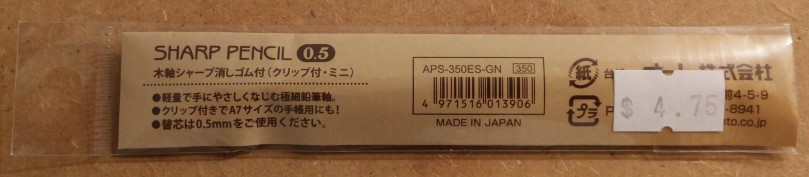
The pencil came in a simple plastic packaging. It opens via a flap on the bottom.

Fit and Finish


IMG_20160313_173909

The finish on the pencil is superb. The lacquer is smooth and the silver foiling is sharp. The clip fits well and does not wiggle. The eraser cap is of a little concern though. While it is firmly attached, there is wiggle associated with it. I believe this is from the entire mechanism inside not being that sturdy.

Design

I believe that this is essentially a wooden pencil without the graphite with a mechanical pencil mechanism stuck in. The mechanism is not attached on the top except for the eraser cap. The end piece where the clip is attached to seems to only provide place for the clip and offers no other purpose.

IMG_20160313_173941

Functionality


I like the form-factor of this pencil, but at the same time, it is its biggest weakness. The pencil feels out of place in the hand, not because it is too short, but because of its diameter. It almost feels like trying to grip a toothpick. I did use it for an entire day of note-taking and found it to be tolerable nearing the end of the day. However, I would definitely recommend a thicker pencil if you want comfort.

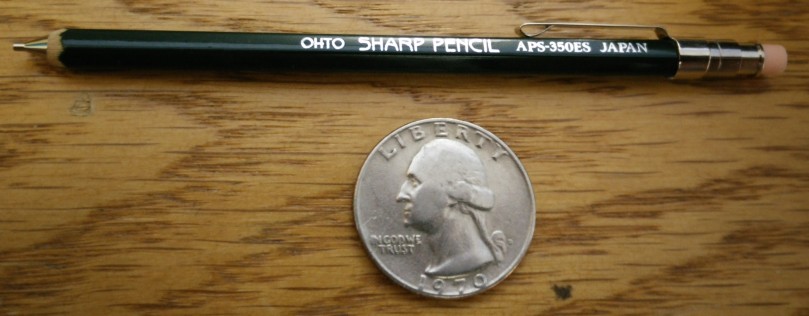
However, due to the length and diameter, this pencil is quite useful in many ways. It can easily be slipped into a pencil case or sleeve as a backup pencil as it does not take up that much room. It can also be placed in a shirt pocket without fear of it making a hole as it is not long enough.

Conclusion

As always, this pencil has a specific purpose and it does it well: it is for convenience, not comfort. It is meant for backup use or a gimmick and not a workhorse. In that regard, it works very well. Don’t force it into tasks it shouldn’t handle and you got yourself a nice mini-pencil.

Mitsubishi White Pencil Review

IntroductionIMG_20160224_231123

I initially saw this pencil online and thought nothing much of it. It’s so plain and simple and seems like one of those “souvenir” or “kids” pencils. However, after seeing guy in person, I knew I had to have it. It’s too bad I didn’t realize how amazing it is. It’s impossible to find them nowadays.*

*Do leave me a message if you know a source for them. You’ll be well rewarded. I promise.

Specs

Place of Manufacture: Japan (?)
Price: 30NTD (~$1)

Background

I bought this pencil at a store in Taiwan called Plain (no affiliation: they have better pictures than I do). They weren’t individually packaged, although they did come with transparent pencil caps. I am not sure whether or not these came from Mitsubishi or if the store owner put them on himself.IMG_20160224_231152

In correspondence with a fellow pencil enthusiasts, I learned that the pencil was also produced in grey. Another spoke of how they also purchased one in Japan. I believe that the pencil was an Asia limited edition in 2014.

Fit and FinishIMG_20160224_231100

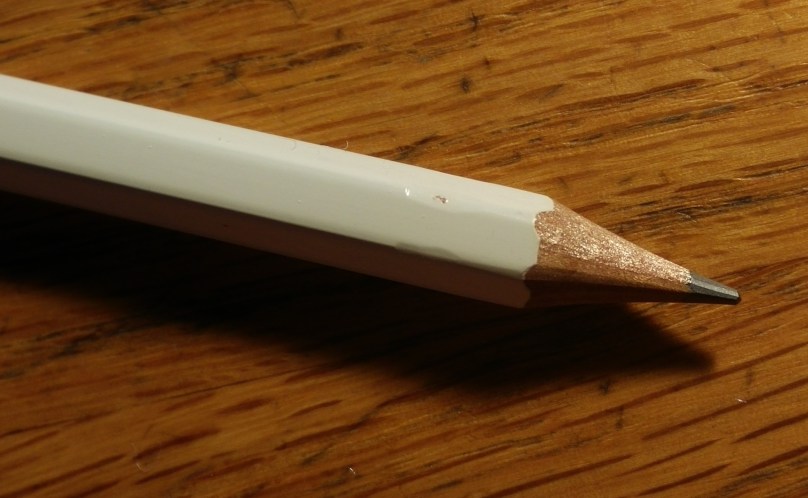
The pencil has great fit and finish. I cannot find any issue with the paint (albeit it is only white). The logo at the end of the pencil appears to be either foil or metallic paint. On my particular example, it seems like the logo might be wearing off a bit.

IMG_20160224_231018The pencil came pre-sharpened at a larger angle. The plastic pencil cap that protects the tip has created dents in the hexagonal body. I don’t believe I had capped/uncapped the pencil enough times to cause the damage myself, so it believe it was caused when the pencil cap was initially pushed on. I have since left the pencil uncapped.
Functionality

The pencil is stated to be of hardness HB although my writing experience (as well as that of the owner of Plain) has found it to be closer to B. The tip does not wear quickly and, in many ways, it writes very similarly to the Hi-Uni.

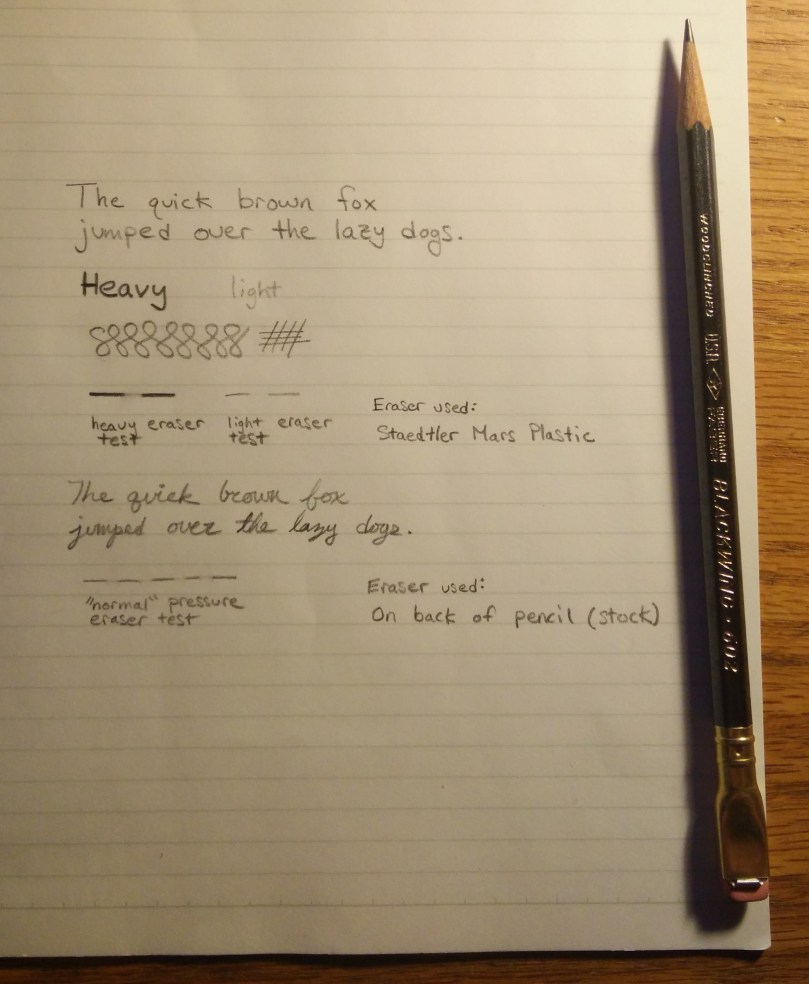
I don’t write with it too often, but here’s a brief writing and erasing sample.

IMG_20160224_231423

ConclusionIMG_20160224_232850

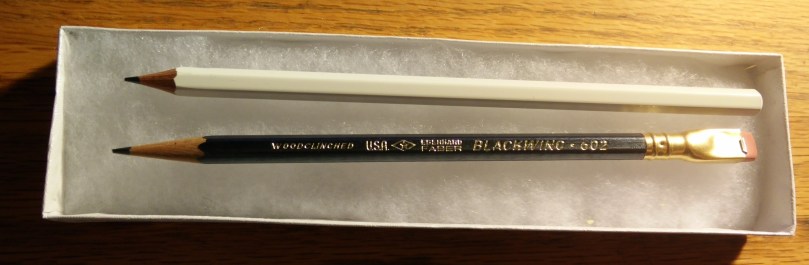
This pencil means a lot to me. It sparked a weird fetish of mine for white pencils and I continue to search for pencils of the sort. This is a pencil for the collection and it sits with my EF Blackwings in a nice padded box. Until I can find more, if possible, that’s where it’ll live.

Eberhard Faber Blackwing 602 (Vintage) Review

Introduction

IMG_20160126_214139

I’ve been a fan of wooden pencils for a while, so when an opportunity fell into my lap to try out a legendary pencil at a fraction of the price for a brand new unsharpened one, I jumped at it. Here, we’ll be discussing the original Eberhard Faber Blackwing 602. A comparison between this pencil and its remake, the Palomino Blackwing 602, can be found here.

Specs

Date manufactured: 1950s-1970s (my guess is that this particular example was made in the 1960s)
Price: $50-60 (New), $20-30 (Used, depends on length)

Fit and Finish

12636827_794968853964061_946472443_o

Pencil has a beautiful charcoal colored lacquer with gold lettering spelling out the iconic “Half the Pressure, Twice the Speed”. Due to age, it appears as though the paint has started to crack down the middle. I would assume that it is cracking where the two halves of the barrel were connected together.

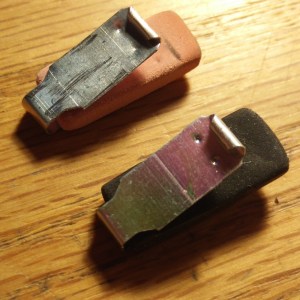
The eraser is held in place with the distinct ferrule. It is easy to replace the eraser if you so wish. Palomino sells many different colored replacement erasers or you can cut one out of your favorite eraser.

Functionality

IMG_20160126_215441

The lead is super smooth. There’s a tad of feedback, although none that could be called scratchy. The lead wears done quickly when sharp, so line variation can vary mid-sentence unless you rotate the pencil. However, writing on a dull point seems to alleviate the problem.

The stock eraser test was done out of pure curiosity. Being a vintage pencil, the eraser has surely somewhat dried out so it’s effectiveness has probably been diminished.

Closeups of each section of the writing test are available below.

Conclusion

The pencil has a writing experience second to none. I regularly use Mitsubishi Hi-Uni’s and 9800’s, but they don’t feel as nice as the Blackwing. It’s hard to describe the combination of smoothness and feedback, but it makes it a joy to write with. Plus, the line it puts down is just a joy to look at. While the price of a new pencil may be a bit steep (and it can be a bit hard to start sharpening a brand new one), a used Blackwing 602 is much more affordable and is a great gateway to experience this legendary pencil.

Blackwing 602: Eberhard Faber vs Palomino

IMG_20160215_214652

The Blackwing 602 might be one of the world’s most famous pencils. In its original iteration, Eberhard Faber created a pencil using fantastic wood and a near magic lead. To this day, there are those who swear by this vintage pencil and hold it second to none. However, for those that aren’t willing to shell out the incredulous sums for a pencil (not even mentioning the dwindling numbers of them), there is the new version made by Palomino. It has a similar color, look and ferrule, but how does it stack up to the vintage marvel?

IMG_20160215_214659

The original Blackwing 602 (reviewed here) feels premium in the hand. The lacquer does not feel or look glossy but, instead, looks matte and feels delicate. On the other hand, the Palomino has a high sheen. It is silky smooth to the touch and it reflects light like fresh snow. I personally prefer the Eberhard Faber paint although the gold foil letter is often too fragile because of age. The Palomino feels like a tank that can hold up to being thrown into a backpack or a pocket.

IMG_20160215_214659

The recognizable ferrule is almost identical on both. On the original, there were a few versions with a black band (these are often more expensive). Erasers are interchangeable and I have no complaints with either.

IMG_20160215_214743

Now for the important part: the graphite. Here’s the brutal truth: I’d be fine with either pencil. Both leads feel smooth gliding across paper. There are minor differences though. The original Blackwing seems to have a tad more feedback than the new one. It’s difficult to describe the feeling as it does not feel scratchy or rough, though you know it’s there. On the other hand, the Palomino is just straight up glass smooth.


Mitsubishi 9800 Review

IMG_20160215_214248Introduction

I’m just going to put it out there: the Mitsubishi 9800 is my favorite production everyday use pencil of all time. I’m not going to say it is better than a Hi-Uni or Swiss Wood or vintage Blackwing, but for the normal workday (or school day), this pencil excels.

Specs

Place of Manufacture: Japan
Price: $7-8 for a box of 12

Packaging

When purchased in a box of 12, you get a nice vintage looking box.

Fit and Finish

IMG_20160215_214346

The pencils have relatively good fit and finish. The paint is consistent and the gold foil is crisp. The quality of the wood is not always the same. Some halves are darker than the others. While it makes no effect with the writing experience or sharpening, it can be a bit of an eyesore. The leads are well centered.

Around the ends, there are times when the edges have chipped paint. I would guess that it occurred either from cutting the wood or when the pencils were being packaged. Once again, it’s not much of a functional issue, but it does affect the aesthetics.

Design

The pencil features a no-nonsense design. There is gold lettering featuring the company name, model and lead hardness. There is no eraser.

FunctionalityIMG_20160215_214419

I love this pencil because of its workhorse abilities. The pencil is light and well balanced because of the lack of ferrule and eraser. One can sharpen it from both ends for long, uninterrupted writing sessions.

The pencil comes in many different lead hardness grades (is that a word?) including HB, B, 2B, F, H, and 2H. I personally like the HB and B grades. The B grade gives a much darker line than the HB grade while the 2B wears down super quickly. Furthermore, the 2B smears very easily. With decent pressure, the HB gives


Conclusion

I use this guy for everything. It’s not supposed to be a safe-queen and you shouldn’t treat it as one. I love it because it’s cheap and reliable. If I could have one pencil in the world, I’d choose a Mitsubishi 9800.