Mitsubishi White Pencil Review

IntroductionIMG_20160224_231123

I initially saw this pencil online and thought nothing much of it. It’s so plain and simple and seems like one of those “souvenir” or “kids” pencils. However, after seeing guy in person, I knew I had to have it. It’s too bad I didn’t realize how amazing it is. It’s impossible to find them nowadays.*

*Do leave me a message if you know a source for them. You’ll be well rewarded. I promise.

Specs

Place of Manufacture: Japan (?)
Price: 30NTD (~$1)

Background

I bought this pencil at a store in Taiwan called Plain (no affiliation: they have better pictures than I do). They weren’t individually packaged, although they did come with transparent pencil caps. I am not sure whether or not these came from Mitsubishi or if the store owner put them on himself.IMG_20160224_231152
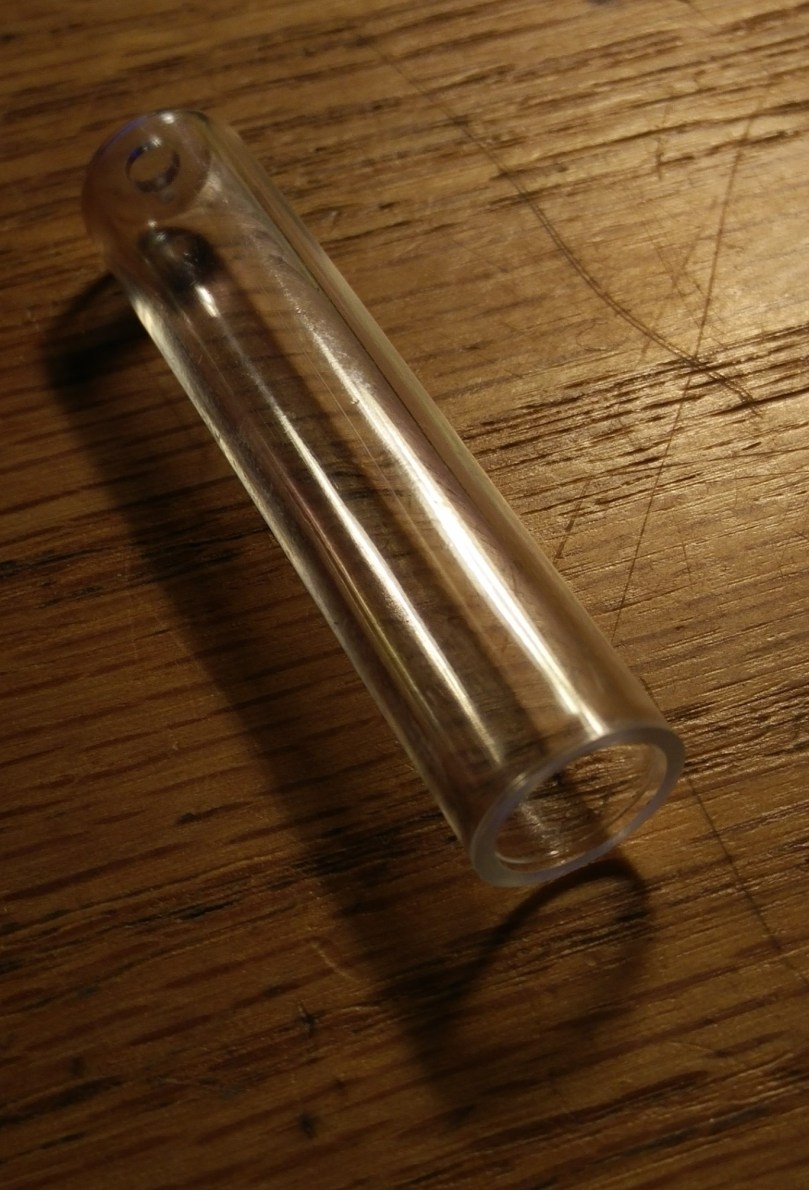
In correspondence with a fellow pencil enthusiasts, I learned that the pencil was also produced in grey. Another spoke of how they also purchased one in Japan. I believe that the pencil was an Asia limited edition in 2014.

Fit and FinishIMG_20160224_231100

The pencil has great fit and finish. I cannot find any issue with the paint (albeit it is only white). The logo at the end of the pencil appears to be either foil or metallic paint. On my particular example, it seems like the logo might be wearing off a bit.
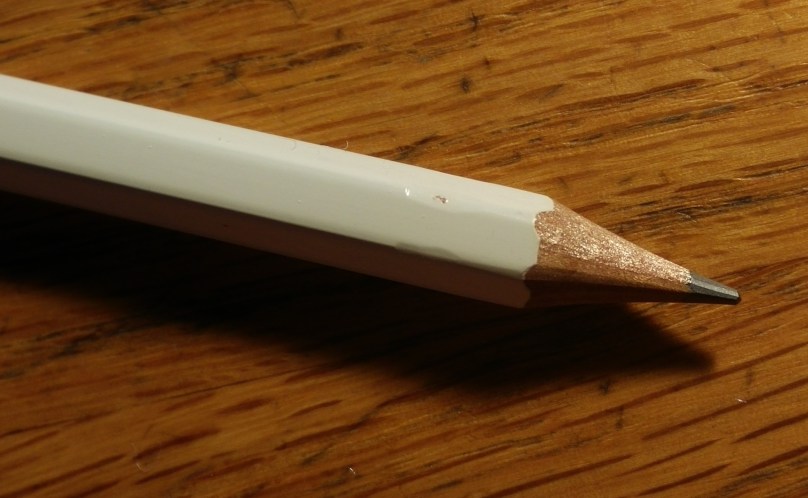
IMG_20160224_231018The pencil came pre-sharpened at a larger angle. The plastic pencil cap that protects the tip has created dents in the hexagonal body. I don’t believe I had capped/uncapped the pencil enough times to cause the damage myself, so it believe it was caused when the pencil cap was initially pushed on. I have since left the pencil uncapped.

Functionality

The pencil is stated to be of hardness HB although my writing experience (as well as that of the owner of Plain) has found it to be closer to B. The tip does not wear quickly and, in many ways, it writes very similarly to the Hi-Uni.

I don’t write with it too often, but here’s a brief writing and erasing sample.

IMG_20160224_231423

ConclusionIMG_20160224_232850

This pencil means a lot to me. It sparked a weird fetish of mine for white pencils and I continue to search for pencils of the sort. This is a pencil for the collection and it sits with my EF Blackwings in a nice padded box. Until I can find more, if possible, that’s where it’ll live.

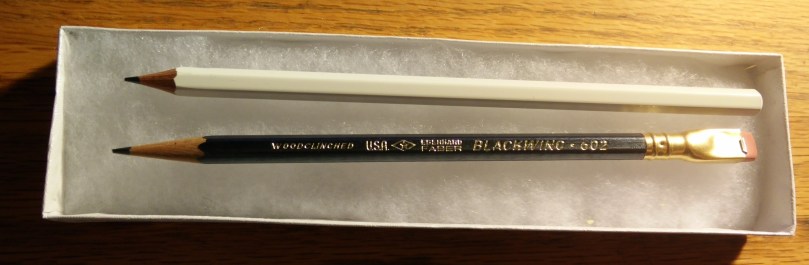
Eberhard Faber Blackwing 602 (Vintage) Review

Introduction

IMG_20160126_214139

I’ve been a fan of wooden pencils for a while, so when an opportunity fell into my lap to try out a legendary pencil at a fraction of the price for a brand new unsharpened one, I jumped at it. Here, we’ll be discussing the original Eberhard Faber Blackwing 602. A comparison between this pencil and its remake, the Palomino Blackwing 602, can be found here.

Specs

Date manufactured: 1950s-1970s (my guess is that this particular example was made in the 1960s)
Price: $50-60 (New), $20-30 (Used, depends on length)

Fit and Finish

12636827_794968853964061_946472443_o

Pencil has a beautiful charcoal colored lacquer with gold lettering spelling out the iconic “Half the Pressure, Twice the Speed”. Due to age, it appears as though the paint has started to crack down the middle. I would assume that it is cracking where the two halves of the barrel were connected together.

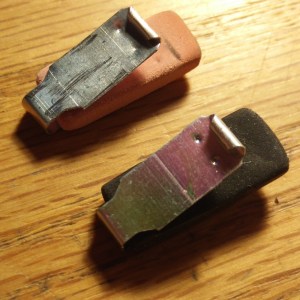
The eraser is held in place with the distinct ferrule. It is easy to replace the eraser if you so wish. Palomino sells many different colored replacement erasers or you can cut one out of your favorite eraser.

Functionality

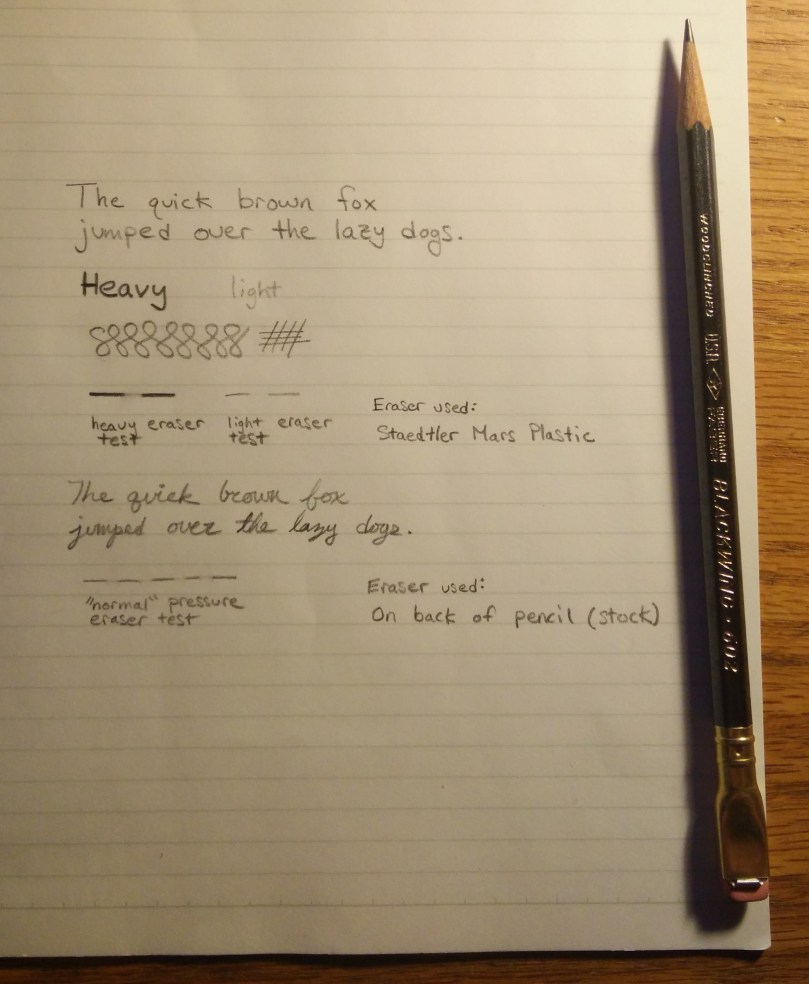
IMG_20160126_215441

The lead is super smooth. There’s a tad of feedback, although none that could be called scratchy. The lead wears done quickly when sharp, so line variation can vary mid-sentence unless you rotate the pencil. However, writing on a dull point seems to alleviate the problem.

The stock eraser test was done out of pure curiosity. Being a vintage pencil, the eraser has surely somewhat dried out so it’s effectiveness has probably been diminished.

Closeups of each section of the writing test are available below.

Conclusion

The pencil has a writing experience second to none. I regularly use Mitsubishi Hi-Uni’s and 9800’s, but they don’t feel as nice as the Blackwing. It’s hard to describe the combination of smoothness and feedback, but it makes it a joy to write with. Plus, the line it puts down is just a joy to look at. While the price of a new pencil may be a bit steep (and it can be a bit hard to start sharpening a brand new one), a used Blackwing 602 is much more affordable and is a great gateway to experience this legendary pencil.

Opinel No8 Stainless Steel Review

IntroductionIMG_20160129_173735

Opinel has been producing knives since 1890. Their basic design, a penny knife with a wooden handle and stamped blade, is iconic and is even part of the permanent collection at New York Museum of Modern Art. I bought for its history and have found it to be one of my most useful tools, whether it’s to sharpen pencils, cut meat, or start a fire. Today, we’ll be looking at a recent production version of their No 8 knife with a stainless steel blade.

Specs

Blade length: 3.75”
Overall length: 7.5”
Weight: 1.6 oz
Price: $10-15

Packaging

The knife came in a simple cardboard box. I have long since thrown out the box but will revise the post to include the packaging from other Opinel knives if I purchase any.

Fit and Finish

At this price range, there is not too much to be expected from the fit and finish. The blade is not centered and the contours of the wood are far from symmetrical. However, in the hand, it does not feel as though anything is wrong. Further, it is actually quite difficult to tell that the knife is not perfect by just glancing at it.

IMG_20160222_001005

The blade is made of Sandvik 12c27 that has been modified by Opinel to have more carbon. Opinel knives originally came with high carbon (0.95%) steels. However, these would easily rust. The Sandvik steel that is used is pretty easily sharpened for a stainless steel. I frequently use my Opinel Sharpening Stone to touch up the blade when needed.

The locking ring is hit or miss. Of my two Opinel No8, one has a tight locking ring while the other is very stiff. I have adjusted them slightly with a pair of pliers (with tape on the tips of course) but still do not feel equal.

FunctionalityIMG_20160129_173827

Opinel sought to create a working man’s knife and they did. The knife is cheap and sharp. The main advantage it has over competitors is the fact that it locks. However, there are many disadvantages. For one, the wooden handle is susceptible to moisture which can cause the wood to swell. When this happens, the knife can become difficult to open.

As the knife is made of stamped steel, some edges are sharp. Most notably, the top edge of the knife is sharp enough to cause discomfort.

That being said, with some simple DIY skills, most of the issues can be solved. The moisture issue can be addressed by disassembling the knife (which will require tools) and coating the knife in linseed oil, polyurethane or something of the like. The handle is easily customized with some sand paper or, if you want a more distinct shape, a saw or knife. There are some custom Opinels with exquisitely filed blade spines (here’s a great example).

My carry version, seen above, has a few coatings of oil on the wood and the edges have been naturally rounded with time. The lock has become a bit loose although I could easily pinch the opening a bit to tighten it. I actually prefer the looser lock as I can lock and unlock it with one hand. This particular knife has been accidentally soaked in water, used to cut sheet metal, and been dropped many times. It still does its job very well and hasn’t given up.

IMG_20160222_001033

One of the most common tasks I do with this knife is sharpen pencils. The convex edge can slide through the wood with ease. It does need to be stropped and honed in order to readily do that though. There are many other knives that can sharpen pencils better (including my Warther wood carving knives and Whale Knife, reviews coming soon), but the Opinel has the advantage of being a folding knife and easier to bring places.

Conclusion

The Opinel is a fine tool to have. Its cheap price and reliability make it a staple for anyone requiring a sharp knife that might be lost or damaged. It has a few shortcomings that can be addressed. This will go in my backpack, for now, but I will be checking other models that Opinel has including different blade lengths, handle materials, and steel types.

Blackwing 602: Eberhard Faber vs Palomino

IMG_20160215_214652

The Blackwing 602 might be one of the world’s most famous pencils. In its original iteration, Eberhard Faber created a pencil using fantastic wood and a near magic lead. To this day, there are those who swear by this vintage pencil and hold it second to none. However, for those that aren’t willing to shell out the incredulous sums for a pencil (not even mentioning the dwindling numbers of them), there is the new version made by Palomino. It has a similar color, look and ferrule, but how does it stack up to the vintage marvel?

IMG_20160215_214659

The original Blackwing 602 (reviewed here) feels premium in the hand. The lacquer does not feel or look glossy but, instead, looks matte and feels delicate. On the other hand, the Palomino has a high sheen. It is silky smooth to the touch and it reflects light like fresh snow. I personally prefer the Eberhard Faber paint although the gold foil letter is often too fragile because of age. The Palomino feels like a tank that can hold up to being thrown into a backpack or a pocket.

IMG_20160215_214659

The recognizable ferrule is almost identical on both. On the original, there were a few versions with a black band (these are often more expensive). Erasers are interchangeable and I have no complaints with either.

IMG_20160215_214743

Now for the important part: the graphite. Here’s the brutal truth: I’d be fine with either pencil. Both leads feel smooth gliding across paper. There are minor differences though. The original Blackwing seems to have a tad more feedback than the new one. It’s difficult to describe the feeling as it does not feel scratchy or rough, though you know it’s there. On the other hand, the Palomino is just straight up glass smooth.


Mitsubishi 9800 Review

IMG_20160215_214248Introduction

I’m just going to put it out there: the Mitsubishi 9800 is my favorite production everyday use pencil of all time. I’m not going to say it is better than a Hi-Uni or Swiss Wood or vintage Blackwing, but for the normal workday (or school day), this pencil excels.

Specs

Place of Manufacture: Japan
Price: $7-8 for a box of 12

Packaging

When purchased in a box of 12, you get a nice vintage looking box.

Fit and Finish

IMG_20160215_214346

The pencils have relatively good fit and finish. The paint is consistent and the gold foil is crisp. The quality of the wood is not always the same. Some halves are darker than the others. While it makes no effect with the writing experience or sharpening, it can be a bit of an eyesore. The leads are well centered.

Around the ends, there are times when the edges have chipped paint. I would guess that it occurred either from cutting the wood or when the pencils were being packaged. Once again, it’s not much of a functional issue, but it does affect the aesthetics.

Design

The pencil features a no-nonsense design. There is gold lettering featuring the company name, model and lead hardness. There is no eraser.

FunctionalityIMG_20160215_214419

I love this pencil because of its workhorse abilities. The pencil is light and well balanced because of the lack of ferrule and eraser. One can sharpen it from both ends for long, uninterrupted writing sessions.

The pencil comes in many different lead hardness grades (is that a word?) including HB, B, 2B, F, H, and 2H. I personally like the HB and B grades. The B grade gives a much darker line than the HB grade while the 2B wears down super quickly. Furthermore, the 2B smears very easily. With decent pressure, the HB gives


Conclusion

I use this guy for everything. It’s not supposed to be a safe-queen and you shouldn’t treat it as one. I love it because it’s cheap and reliable. If I could have one pencil in the world, I’d choose a Mitsubishi 9800.

Rotring 600 0.5mm Review

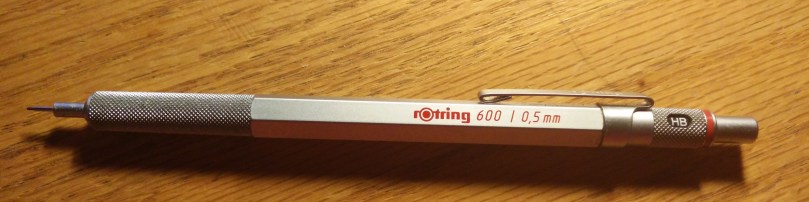
IntroductionIMG_20160127_232013

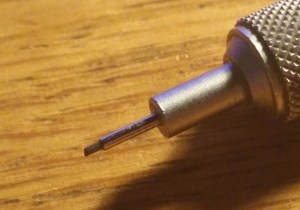
When one talks about premium mechanical pencils, there are usually two ways the conversation can go: luxury or drafting. Here, we discuss one of the most common drafting pencils. The Rotring 600 has been around for a while (still researching its history) though its newest version began in the 1990s with Rotring having been bought out by Sanford. It has a very fragile tip that many new users have bent beyond repair and a price that is way above similar Pilot and Uni offerings. So, how does Rotring stand up to the lore it carries?

Specs

Lead size: 0.35mm (effectively 0.3mm), 0.5mm, 0.7mm, 0.9mm
Country of Manufacture: Japan
Price: $50 (Retail), $20-25 (Amazon)

Packaging

The Rotring comes in a lackluster cardboard box. While the Midori Pen Case also came in a cardboard box, the Rotring’s feels noticeably cheaper. Inside, there is a cardboard divider forcing the pencil into a snug corner. The pencil is sheathed in a plastic bag which it can easily slip out of (which can give a scare to the one opening the packaging). On the other side of the divider, there is a small information pamphlet that provides some general use tips and warranty information.

Fit and Finish

Upon holding the pencil, the first reaction most people have is “this is so heavy” and it’s true. At around 20 grams (more accurate number to come), the pencil is much heavier than store bought Bic mechanical pencils.

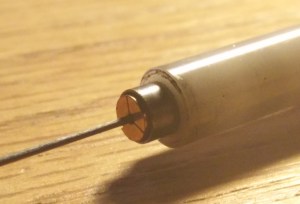
Taking the pencil apart, one finds that there is a minimum of plastic components. I’ve done some research on the history of the pencil to find out that the internal mechanism used to be completely metal. However, the plastic in the pencil does not feel weak and I do not fear that it will fail to work anytime soon.IMG_20160127_232325

Functionality

Holding the pencil is a joy. The knurled grip provides a wonderful surface to hold. The Alvin Draft-Matic (a similar pencil based on the Rotring 500) has a sharper grip that can be painful to hold for long periods.IMG_20160127_232229

The mechanism seems to take any type of lead. I have fed HB, B, and 2B leads from different manufactures and no single brand seems to break more often. As a matter of fact, even though it has a thin tip, lead breakages are seldom and are mostly from user error.IMG_20160127_232409

The thin tip is an area of concern. Having seen many pictures of the result of fallen pencils (most should be marked “nsfw”), when I bought the pencil, I immediately dug up an old tin pencil case from my childhood to protect the pencil when I took it from my desk. It has since been replaced with a Midori Pen Case.IMG_20160127_232503

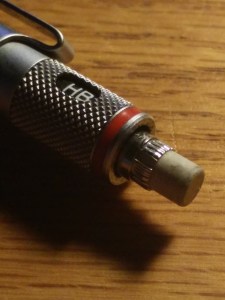
I have not used the eraser although I will note that it is about the same size as Pilot P20x series pencil erasers. It feels like it is on the dry side.IMG_20160127_232119


Conclusion

The Rotring 600 is a wonderful pencil. It is easy to write with it for long periods of time and it is very robust, sans the tip. This is one for the pocket.

Midori Brass Pen Case Review

originally published 1/26/2016
last edited and revised: 8/3/2016

IntroductionIMG_20160126_140625

Among my most prized stationery possessions is my Midori Brass Pen Case. It’s a little hefty, has some sharp edges, and doesn’t hold the most, but it has built a personal connection with me, during the time that I’ve owned it, that gives it a special place in my collection.

Check out my current EDC rotation to see how it fits in with everything else.

Specifications

Dimensions: 5cm (width) x 17cm (length) x 1.8cm (height)
Weight: Around 160g
Place of Manufacture: Japan
Price: $76 (retail), $30-50 (street)

Packaging

IMG_20160126_140818

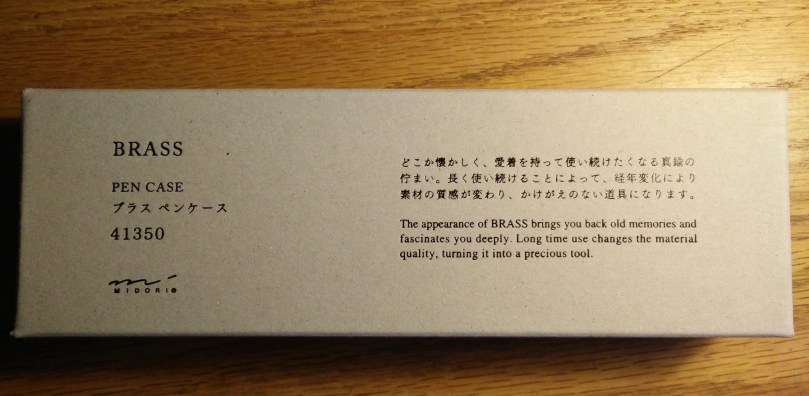
The pen case comes in a nice cardboard box made of two halves. They are well fitted, albeit on the loose side. The top of the box has black lettering that is imprinted into the cardboard. The words are sharp and legible. The text itself is in both Japanese and English.

English text: “The appearance of Brass brings you back old memories and fascinates you deeply. Long time use changes the material quality, turning it into a precious tool.”

IMG_20160515_224401

Inside, the pen case is wrapped with with a paper sleeve. The sleeve unfolds with some instructions on the inside. It is written in Japanese, so I am unable to read what is written.

Fit and Finish

IMG_20160224_194645

The pen case is built very sturdily. There is very little flex when bending the lid and practically none with the base. The two halves fit together very well although there is a bit of wiggle room when the lid is attached. I assume that if the tolerances were any closer, it would be much harder to place the lid on.

The issue with the pen case are the sharp edges. Both the top and bottom halves are made of one piece of brass and, as such, the top and bottom edges are rounded and smooth to the touch. However, the open edge is extremely sharp. It would appear as though there was no finishing done to the edge after the metal was cut. While not sharp enough to cut one’s skin, it is uncomfortable to brush your hand up against it. It has somewhat smoothed out with use though.

FunctionalityIMG_20160126_140739

The pen case does not have a large capacity. When considering length, it is not long enough to hold an unsharpened or newly sharpened pencil. With length and width, one can stack around 8 pencils.

I usually keep:

  • Rotring 600 0,5 mechanical pencil
  • Staedtler Mars plastic push eraser
  • Mitsubishi Hi-Uni 0.5 HB pencil lead

The items do rattle and there are a fair number of scratches from the knurled grip of the Rotring.

If I want to bring woodcased pencils out, I have to select pencils that are short enough to fit. However, it will comfortably hold 2-3 with a small eraser and a single hold sharpener.

I was initially concerned about possibly denting the pencil case when I brought it out. The case is quite thick, but as a student, there are many opportunities for my backpack to be bumped into and stepped on. I recently saw a dent in one of the corners of the case.

IMG_20160224_194514

It is not very obvious, but it just goes to show that the case is not bulletproof and is subject to damage.

I was surprised when I figured out that the pen case fit almost perfectly in the largest slot of my Pilot pen roll (Item number PCS121-80.). Since then, whenever I bring the Midori pen case out, I stuff it in the pen roll and throw it into my bag.

Conclusion

I love this pen(cil) case. There’s no doubt that Midori has produced a well made, durable container that will serve me well. I don’t see how it can ever be damaged to the point of not being usable (sans extreme destruction). I will definitely be keeping it and using it for years to come.

IMG_20160224_194558