Alan Folts TiStix Review

Introduction

Titanium is all the craze nowadays. With food utensils, they provide a distinct advantage over steel, with properties such as anti-corrosion and weight being among the most notable. However, Titanium tools are often much more expensive as they are harder to work with. When it comes to something as simple as chopsticks, does the added cost still make them worth it to buy?

This product was provided by EatingTools for review.

Specs

Manufacturer: Alan Folts
Place of Manufacture: USA
Length: 9.375″
Weight: 1.7oz
Price: $75 (link to purchase: here)

Packaging

IMG_20160817_082432

The TiStix come in a nice black sleeve packaging. There is a small loop that slips over the flap to keep it closed. Over the left side has the logo printed on faintly.

When it comes to packaging, the TiStix really hit the ball out of the park. I can see myself reusing this packaging for months if I continue to be careful about drying them off before putting them back.

Design

The TiStix are cut and milled at a small machine shop in South Carolina. After that, the TiStix are finished by hand by Alan Folts. This includes the anodizing, polishing, and bead blasting.

IMG_20160817_082544

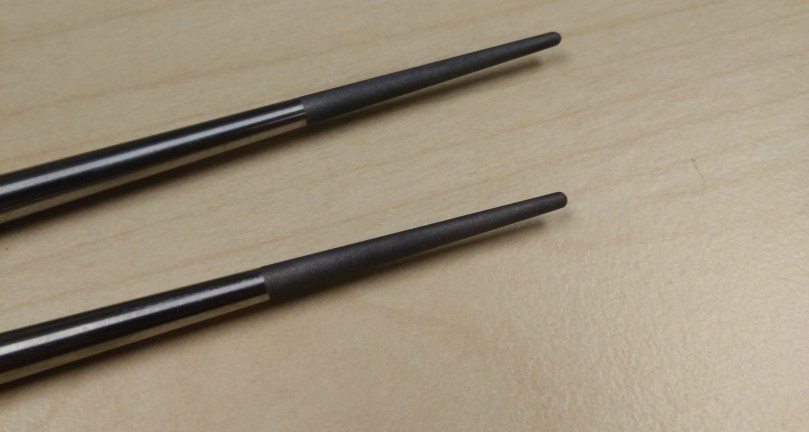
Starting at the tip, the front inch are bead blasted. This gives them some more grip and contrasts with the rest of the polished body.
IMG_20160817_082606

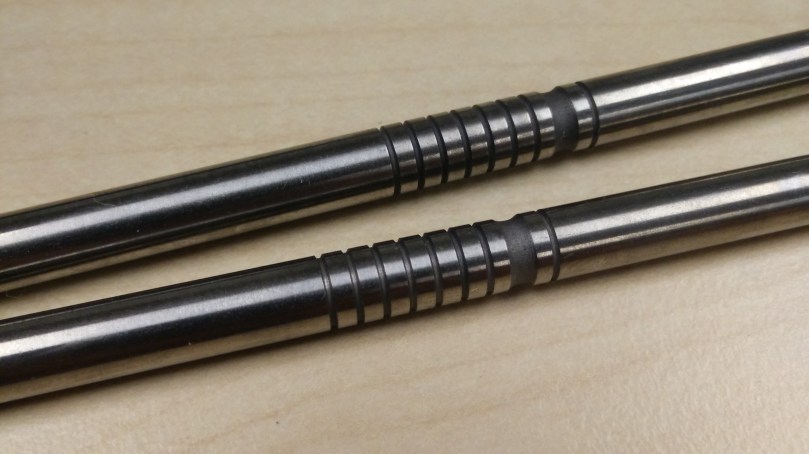
Moving to the middle, there is some milling that add to the aesthetic. The largest milled ring are bead blasted for higher contrast. The other milled rings are not finished differently from the body.
IMG_20160817_082612

The end is bead blasted and is steeply tapered into a dulled tip. There is more milling here and, like before, only the largest ring is bead blasted.

IMG_20160817_082553

Other models come with different color anodizations that add some customizability.

Fit and Finish

The fit and finish on the TiStix are impeccable. It is impossible to tell the individual sticks apart from their size. This is expected, as they were professionally machined. The milled rings are distanced the same on both and the depths are the same.

When it comes to finish, even though the TiStix are finished by hand, they look perfect. The polished surfaces look smooth. They look a bit tumbled, which would explain their ability to resist wear marks. They frankly look like pieces of art rather than eating utensils.

Functionality
IMG_20160822_222141

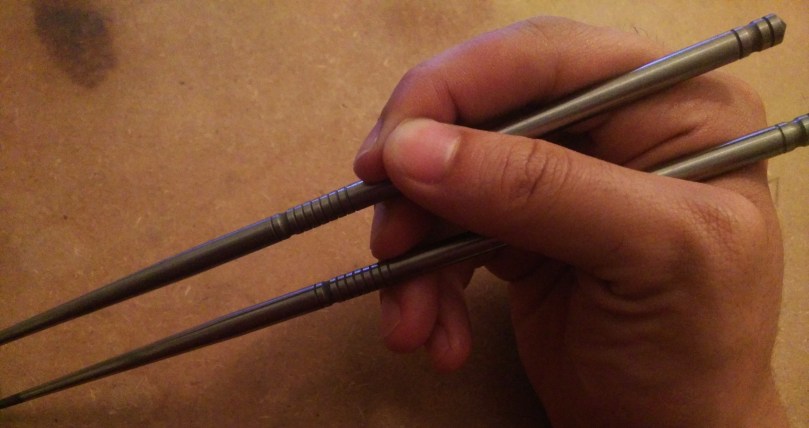
I was a bit dubious at first about any differences the TiStix would have over other chopsticks. I was, however, pleasantly surprised by the weight increase. It might seem like a hindrance, but the added weight shifts the center of balance closer to the hand. As such, they are much easier to control. Further, the titanium has a slightly “grippier” feel in comparison to stainless steel. While not as textured as something like bamboo or wood, the TiStix makes up it by being much heftier.

IMG_20160822_220704

The sandblasted tips make it easy to pick up the most slippery of items. This contrasts greatly with other types of chopsticks that either do not have any type of feature to help with gripping, or those that simply have a few grooves cut into the tip.
IMG_20160822_220757

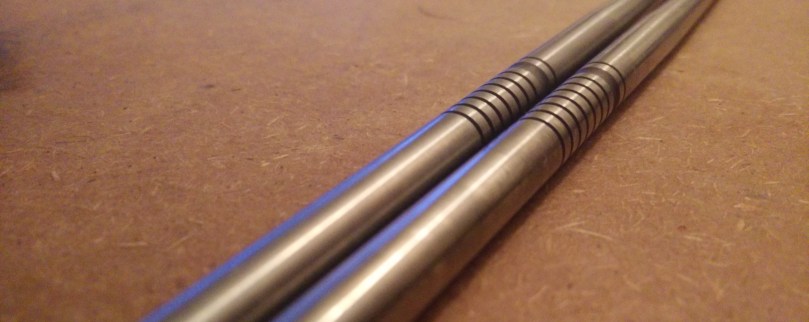
When it comes to cleaning, the titanium holds up very well to scrubbing and does not stain. Using a sponge and some dish soap, it took no time at all to remove hardened food gunk off of them. The milled titanium rings are not deep enough to make cleaning them difficult. The bead blasted contrast remains after cleaning.

Value and Competition

At $75, the TiStix do not come cheap. However, the price can be justified. In comparison to other titanium chopsticks, the TiStix’s design, with its milling and bead blasting, showcase a higher level of workmanship. The ergonomics are also better, with the strong tapering putting the center of mass higher up than with other chopsticks.

IMG_20160822_223041

When considering value, one should look at both the item itself and how it compares. While the TiStix may look simple, they handily beat out the competition through it’s design and attention to detail. These additional design aspects require more workmanship, which further rationalize its price. For those reasons, I feel like the TiStix are reasonably priced and present tangible advantages to its competitors.

Conclusion

I was a bit surprised by the TiStix. As someone who has used chopsticks for many, many years, the TiStix may be the best pair of chopsticks that I have ever used. This is not an exaggeration. The higher center of mass and bead blasted tips make grabbing food a breeze. With their hardy solid, one piece construction, I have no fear of bringing them out and using them in lieu of disposable utensils. Given the opportunity, I would definitely purchase many more pairs for household use.

American Kami Stubby Spork Review

Introduction

The spork is a combination of a fork and a spoon. It can be difficult to design the utensil to get both the utility of a fork and a spoon. If the fork prongs are too long, then the spoon cannot hold much liquid. If the spoon is too big, it will unwieldy. DJ Urbanovsky, from American Kami, has created what might be the beefiest spork on the market. But is this just a niche product, or is this a spork that everyone can appreciate?

This product was provided by EatingTools for review.

Specs

Place of Manufacture: USA
Length: 6.85 inches
Weight: 1oz (30g)
Material: 6AL4V Titanium
Price: $30 USD from EatingTools

Design

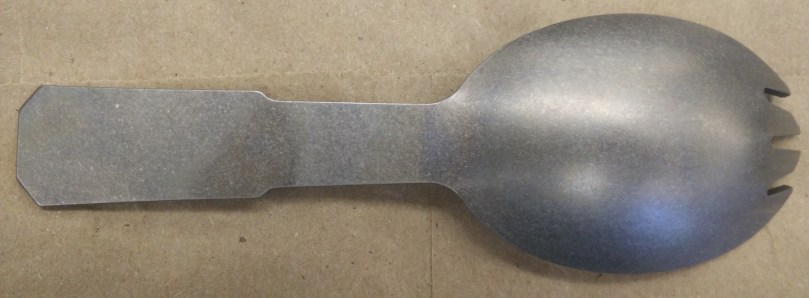
The spork holds true to its name of being stubby. With an over all length of 5.25″ and handle length of 2.75″, the size of bowl is quite overbearing in comparison to the rest of the spork.

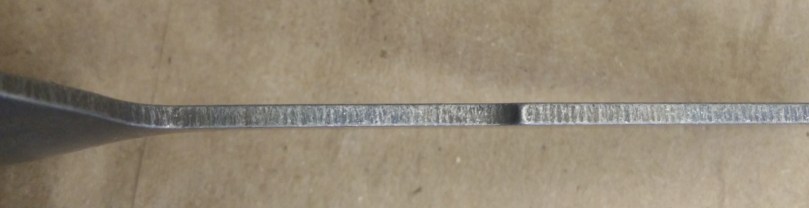
The spork is made of US aerospace and military scrap 6AL4V  titanium. It is 0.071″ thick, which gives it strength and heft.

The handle shape steps down before tapering into the bow. The connection between the handle and the bowl is abrupt, although there are no sharp edges.

IMG_20160811_155648

The bowl itself is wide and deep. The tines are not too long and, as such, it has a higher fluid capacity compared to most sporks.

There are three other models of this spork created by American Kami. They all have longer handles, with some longer than others, and there is a variation on the handle that has a bottle opener.

Fit and Finish

The spork is handmade by DJ Urbanovsky, of American Kami, using dies. There are a few indications that the product is handmade. Some parts of the bowl in between the tines show stretching and compression, most obviously between the tines. Further, one of the middle tines is slightly longer than the other.

IMG_20160811_155945

Along the edges of the spork, there is a coin-edge-like finish. It is not rough and adds a certain aesthetic to the spork.

IMG_20160811_160037

The anodization is done by hand and, as such, there is some color variation between the handle and the bowl.

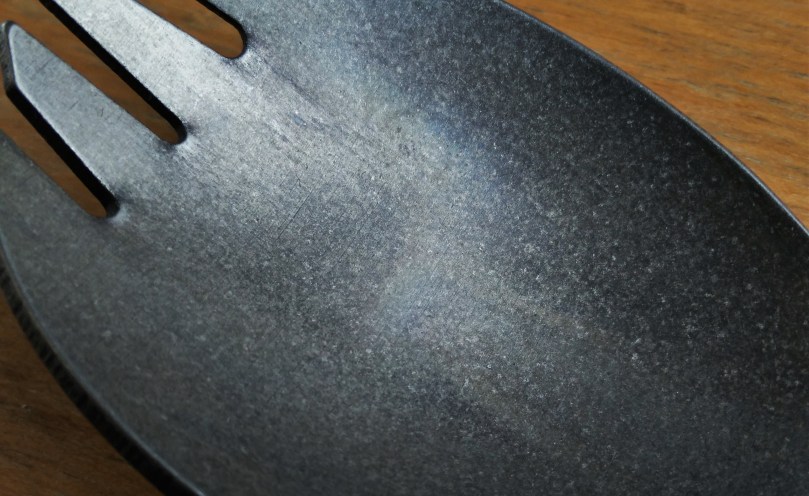
In the bowl itself, there is some really beautiful color depth in the anodization.

IMG_20160816_150013

Functionality

The spork does well in its intended purpose. The large bowl holds a large volume while not becoming cumbersome. The tines are dull and do not feel sharp at all. Overall, the eating experience is wonderful.

IMG_20160817_142037

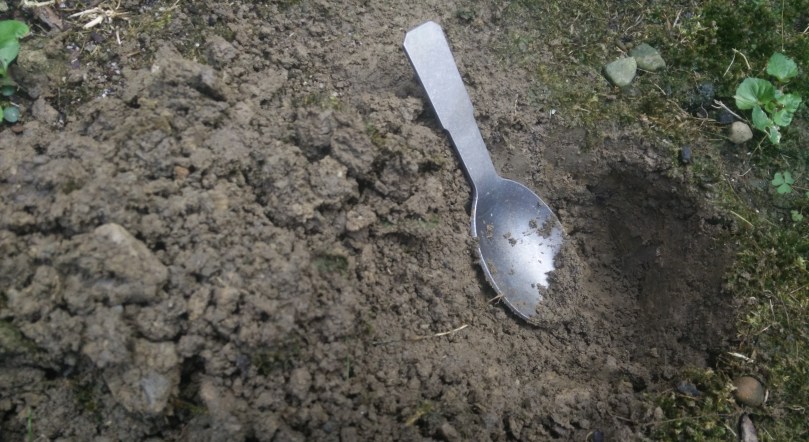
There are some other uses that will take advantage of the beefy build. I took the spork out to put it to some unconventional tasks and it fared quite well. It was easy to dig through top soil and even clay. I did not feel any bending. The tines encountered small roots and pebbles during this test.

IMG_20160810_154017

I washed off the spork using a Scotch-Brite sponge. The stonewashed finish held up very well, with scratches blending into the finish and the anodization looking unchanged.

IMG_20160810_180746

With its small size, the spork can easily be dropped into a pocket or thrown into a backpack without being obtrusive. While this model does not have any holes drilled into the handle for a lanyard, unlike other models, its size would have made a lanyard an annoyance for use.

Conclusion

DJ Urbanovsky has created an indestructible spork. However, it does not give up functionality with its heft. Instead, the large bowl and effective fork tines make eating meals a breeze. The short, stubby length is very convenient while still being useful. This spork will replace my Snow Peak Titanium Spork as my go-to eating tool and will certainly prove to be a useful companion.

IMG_20160816_145839

Pentel Clic Eraser Review

Introduction

IMG_20160804_230200

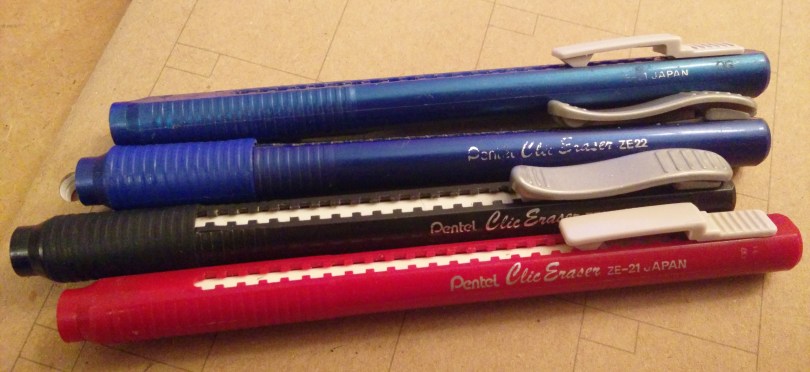
I like push erasers. They provide a precise, long lasting erasing in a compact form-factor. However, since an eraser only erases as good as the eraser material, not only is the design of the push-mechanism important, but the refills themselves have to be decent.

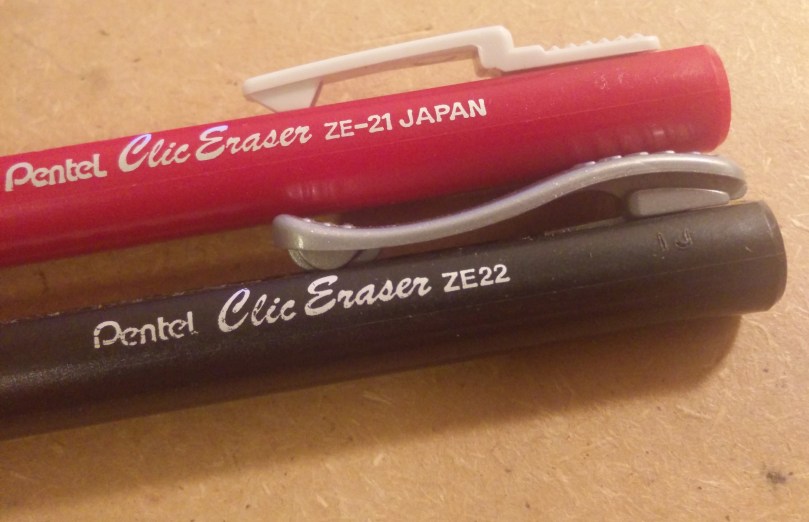
The Pentel ZE-21 and the Pentel ZE-22 are the two models of “Clic” push erasers. The ZE-22 can still be purchased at local office supply stores, while the ZE-21 has been discontinued. Today, we’ll be taking a look at the two and I’ll be explaining why the Pentel “Clic Eraser” ZE-21 is in my EDC.

Specs

Place of manufacture: Japan
Price: $3 (ZE-21, must be purchased from reseller), $4 for four (ZE-22), $16 (box of 24 ZER-2 refills)

Design

IMG_20160523_233251.jpg

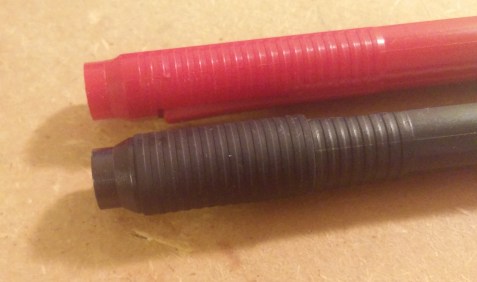
The ZE-21 is made completely from plastic while the ZE-22 has a plastic body with a rubber grip. On both, pushing the pocket clip down and then forward extends the eraser. The clip assembly holds the eraser refill through friction.

On the ZE-21, the body is smooth down to the grip, which is simply the same material, but ribbed. It is not particularly grippy, but is textured enough to get a firm grasp on when erasing.

IMG_20160523_233303.jpg

IMG_20160804_225544
ZE-22 (right), ZE-21 (left)

The ZE-22 on the other hand has textured plastic, as well as a rubber grip with a texture of the same design. This adds a few millimeters to the diameter. The rubber is soft and can be removed.

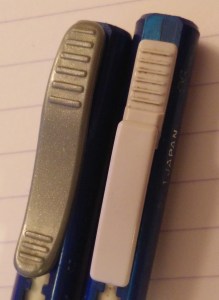
The clips have slightly different designs with the ZE-21 having a flatter and more boxy look while the ZE-22 has more curves. The plastic used for the clip is darker and has a shiner finish on the ZE-22, which matches the type of plastic used on the body. On the other hand, the plastic used on the ZE-21 is duller and feels a tad rougher.

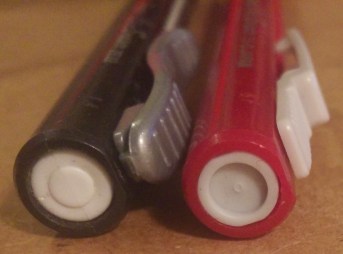
The end caps on the ZE-21 and the ZE-22 differ a bit, with the ZE-21 having a more refined look with an indentation, while the ZE-22 is flatter. The flatter look accentuates the molding lines on the plastic, although the ZE-21 has a very noticeable bump in the middle of the cap.

IMG_20160523_233351.jpg

The refill comes either in boxes of 24 or individually. The individual refills are packaged in thin plastic with a sheet with instructions surrounding the refill itself.

Though the model number is ZER-2, it appears that the “2” was not stamped on this particular packaging or that the packaging is generic.

Fit and Finish

IMG_20160806_110314

The product was not meant to be an expensive one and the fit and finish is reflective of this. There are molding lines on the plastic and the parts have uneven colors. The lettering on the body is a bit uneven and is prone to wear.

Functionality

The first thing you notice when you see my ZE-21 is that the paint has worn off the body. I didn’t intentionally scrape the paint off with my nail, but instead, the paint wore off through use and wear in wherever it was thrown into. The force required to extend the eraser has lessened over time, although this is only obvious through the different sounding clicks that it makes.

IMG_20160806_110955
Eraser Test on Rhodia Notebook

ZE-21 vs ZE-22

With respect to erasability, since the refills are identical, they have the same performance. However, while the eraser holders look similar and share many attributes, their differences make one superior, in my opinion, to the other.

IMG_20160523_233308.jpg

The ZE-22’s action does not feel sturdy after multiple uses. I believe this to be because of the design of the clip itself. The clip, while stylish, is connected by a thin piece of plastic. On the other hand, the ZE-21 is held together with a shorter piece of thin plastic, giving it less wiggle.

IMG_20160809_222409

Further, the ZE-22’s grip “improvement” is a short term and unnecessary improvement. With the rubber grip, the ZE-22 is no longer able to be placed flat on a surface. Further, the grip accumulates dirt and grime quickly. After a while, the elasticity of the rubber will degrade and the grip will not fit flush with the body of the eraser.

IMG_20160523_233105

The ZE-21, on the other hand, is simply one piece of plastic. As such, it’s only weakness is the “press” tab on the side of the eraser, which can lose its tension over time. This tab can However, as this is not necessary for the eraser’s usability, it is not important that it remain in perfect condition.

Conclusion

The push eraser has a special place in a stationery user’s arsenal. It is compact and convenient while providing accurate erasing. The Pentel Clic series uses the polymer eraser refills that Pentel is known for in a mechanism that is cheap and simple. While Pentel has tried to improve on the product, the older ZE-21, in my opinion, beats out the newer ZE-22. However, either eraser would prove to be useful and, at this price point, getting a few spares won’t break the bank.